Datasets based on the Global Tide and Surge Model (GTSM-based datasets)
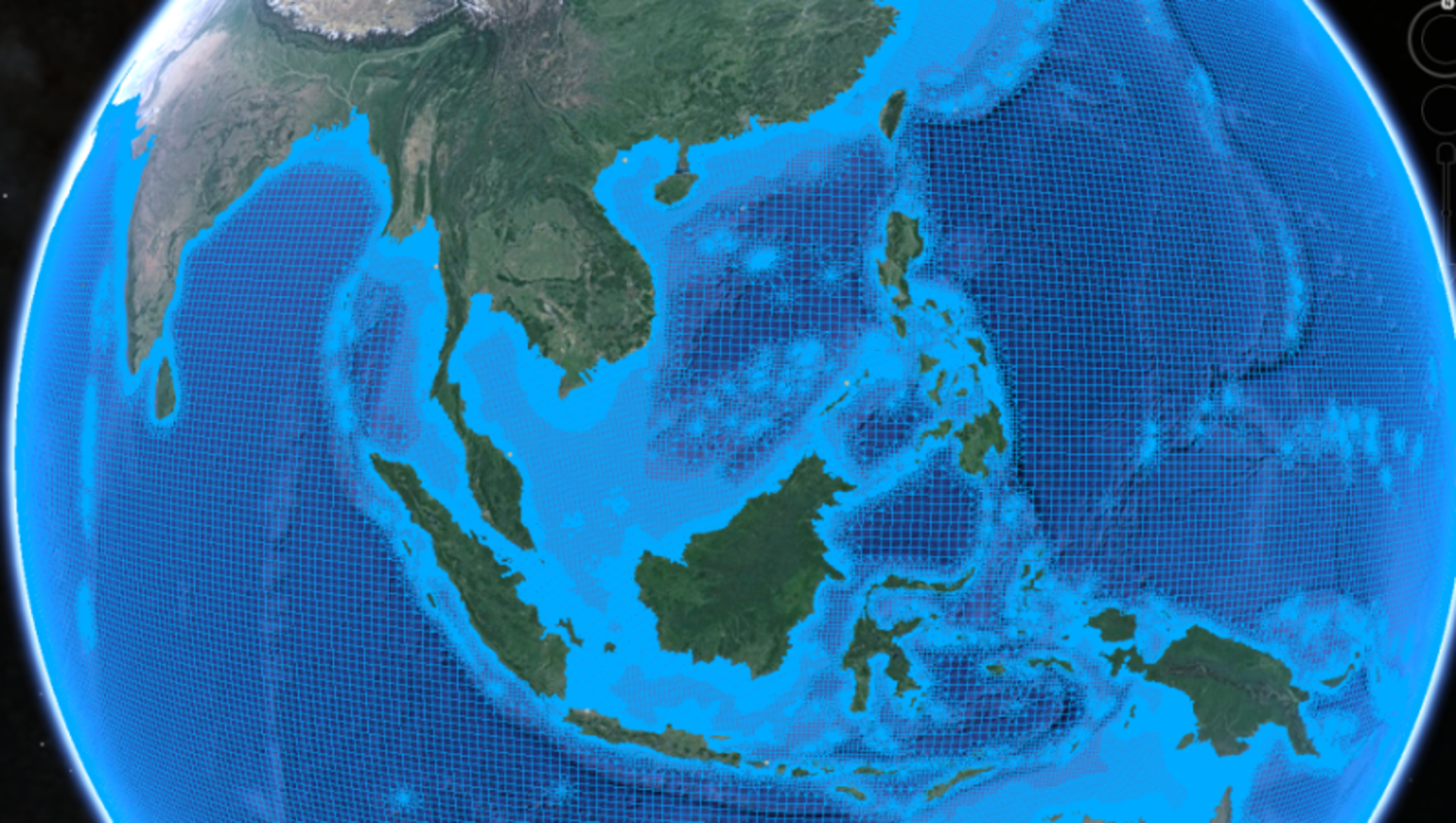
Global Tide and Surge Model (GTSM) is a depth-averaged hydrodynamic model with global coverage, developed by Deltares. GTSM can be used to simulate water levels and currents, that arise from tides and storm surges. GTSM is based on Delft3D Flexible Mesh software and has a spatially varying resolution which increases towards the coast. Because of this, GTSM has a uniquely high resolution at the coast, which makes that coastal water levels are accurately resolved while being computationally efficient. More details about the model can be found here.
Extreme sea levels, caused by storms and high tides, can cause coastal flooding and erosion. With sea-level rise and climate change, low-lying areas around to world will experience increased risks. To mitigate these risks, there is a need for accurate forecasts on when and where extreme sea level will occur and a good understanding how risks will change in the future. GTSM is an important tool in this context and is used for a wide range of applications, which include operational forecasting, reanalysis of historical extremes, and climate change projections. Within WCR we apply the GTSM model to assess coastal flood risk at large-scales.
Within WCR, we apply GTSM to assess the probabilties of extreme sea levels and coastal flooding. We have developed various open-source datasets that are used for flood risk assessments. Here we provide an overview,
Datasets
Global Tide and Surge Reanalysis (GTSR)
The GTSR dataset provided the first global reanalysis of extreme sea levels at the coast (Muis et al., 2016). The dataset is based on GSTMv2.0 forced with ERA-Interim for storm surges and FES2012 for tides. It covers the period from 1979 to 2014 and return periods. Global daily maxima and return periods are openly available at: here. The dataset has been used for global flood risk assessments presented in various web-based tools such as Aqueduct 1.0, Surging Seas, ThinkHazard! from the World Bank.
Coastal Dataset for Evaluation of Climate impact (CoDEC)
CoDEC dataset, an update of the GTSR daset, provides a waterlevel, surge and tides reanalysis and climate projections (Muis et al., 2020), including both timeseries and statistics such as return periods. The reanalysis based on ERA5 and climate projections are carried out for a single CMIP5 model (CORDEX for Europe) using GTSMv3.0. European dataset is available at the Copernicus Climate Data Store: here for indicators, and here for timeseries. Global return periods are available at Zenodo: here.
Global Tide and Surge Model intercomparison project (GTSMip)
GTSMip provides multi-model projections from 1950 to 2050 based on 5 climate models from the HighResMIP experiments, and including annually updated sea-level rise. Global data are available at the C3S Climate Data Store. Timeseries: here and indicators: here.
Global COastal dAtaset of Storm Tide Return Periods (COAST-RP)
COAST-RP (Dullaart et al., 2021) dataset can be seen as an extension of the CoDEC dataset. COoDEC underestimates extremes in regions prone to tropical cyclones, both due to lack of spatial resolution of ERA5 as well as the limited length of the record. COAST-RP combines the ERA5 reanalysis with the STORM dataset with synthetic tropical cyclones and provide return levels of total water levels, including low-probability extremes. The COAST-RP dataset contains storm tide levels representing the 1, 2, 5, 10, 25, 50, 100, 250, 500, and 1000-year return period. Global data are available at 4TU Data Centre: here.
Atlantic Tide and Surge Reanalysis (ATSR)
Extreme sea levels along the western North-Atlantic coasts based on a modified global framework (Muis et al., 2016) to better include tropical cyclones (Muis et al., 2019. The dataset provides time-series of tides and surges from 1988-2015 for the western North-Atlantic coastline (U.S., Canada, Central America and Carribean). Simulations are based on the Global Tide and Surge Model version 2.0. Tropical cyclones are explicitly included based on the Extended Best Track dataset and the Holland parametric cyclone model. Daily maxima of the surge and total waters are openly available at the archive of the 4TU. Research Data here.
Extreme sea levels during the Last Interglacial
GTSMv3.0 was used to explore changes in storm surge levels between climates of the last interglacial and the pre-industrial (Scussolini et al., 2023). The datasets for both time periods are openly available here and here.
HGRAPHER
People








Source code
You can find all GTSM model source code on the Deltares website, alongside documentation here.
Publications
- 1
Nadia Bloemendaal, Sanne Muis, Reindert J Haarsma, Martin Verlaan, Maialen Irazoqui Apecechea, Hans de Moel, Philip J Ward, and Jeroen CJH Aerts. Global modeling of tropical cyclone storm surges using high-resolution forecasts. Climate Dynamics, 52:5031–5044, 2019.
- 2
Job CM Dullaart, Sanne Muis, Nadia Bloemendaal, and Jeroen CJH Aerts. Advancing global storm surge modelling using the new era5 climate reanalysis. Climate Dynamics, 54:1007–1021, 2020.
- 3
Job CM Dullaart, Sanne Muis, Nadia Bloemendaal, Maria V Chertova, Anaïs Couasnon, and Jeroen CJH Aerts. Accounting for tropical cyclones more than doubles the global population exposed to low-probability coastal flooding. Communications Earth & Environment, 2(1):135, 2021.
- 4
Sanne Muis, Maialen Irazoqui Apecechea, Job Dullaart, Joao de Lima Rego, Kristine Skovgaard Madsen, Jian Su, Kun Yan, and Martin Verlaan. A high-resolution global dataset of extreme sea levels, tides, and storm surges, including future projections. Frontiers in Marine Science, 7:263, 2020.
- 5
Sanne Muis, Ivan D Haigh, Gabriela Guimarães Nobre, Jeroen CJH Aerts, and Philip J Ward. Influence of el niño-southern oscillation on global coastal flooding. Earth's Future, 6(9):1311–1322, 2018.
- 6
Sanne Muis, Ning Lin, Martin Verlaan, Hessel C Winsemius, Philip J Ward, and Jeroen CJH Aerts. Spatiotemporal patterns of extreme sea levels along the western north-atlantic coasts. Scientific reports, 9(1):3391, 2019.
- 7(1,2)
Sanne Muis, Martin Verlaan, Hessel C Winsemius, Jeroen CJH Aerts, and Philip J Ward. A global reanalysis of storm surges and extreme sea levels. Nature Communications, 7(1):11969, 2016.
- 8
Paolo Scussolini, Job Dullaart, Sanne Muis, Alessio Rovere, Pepijn Bakker, Dim Coumou, Hans Renssen, Philip J Ward, and Jeroen CJH Aerts. Modeled storm surge changes in a warmer world: the last interglacial. Climate of the Past, 19(1):141–157, 2023.